
Market figures in this article are as of the first half of 2026. Last updated November 2, 2026.
Quick answer: Data center civil engineering covers everything outside the building that has to be right before power, steel and racks can arrive: site feasibility, mass grading and building pads, erosion control, stormwater, water and sewer, fire access, heavy-haul roads, substation pads and duct-bank corridors. In Georgia, the most cost-effective approach is to split the civil plan set into sequenced permit packages (an early-works land disturbance package first, then campus backbone utilities, then building-specific packages) so earthwork can start while later design is still being finished. Civil work is a modest share of a data center budget, but it sits on the critical path of almost every schedule.
Key takeaways
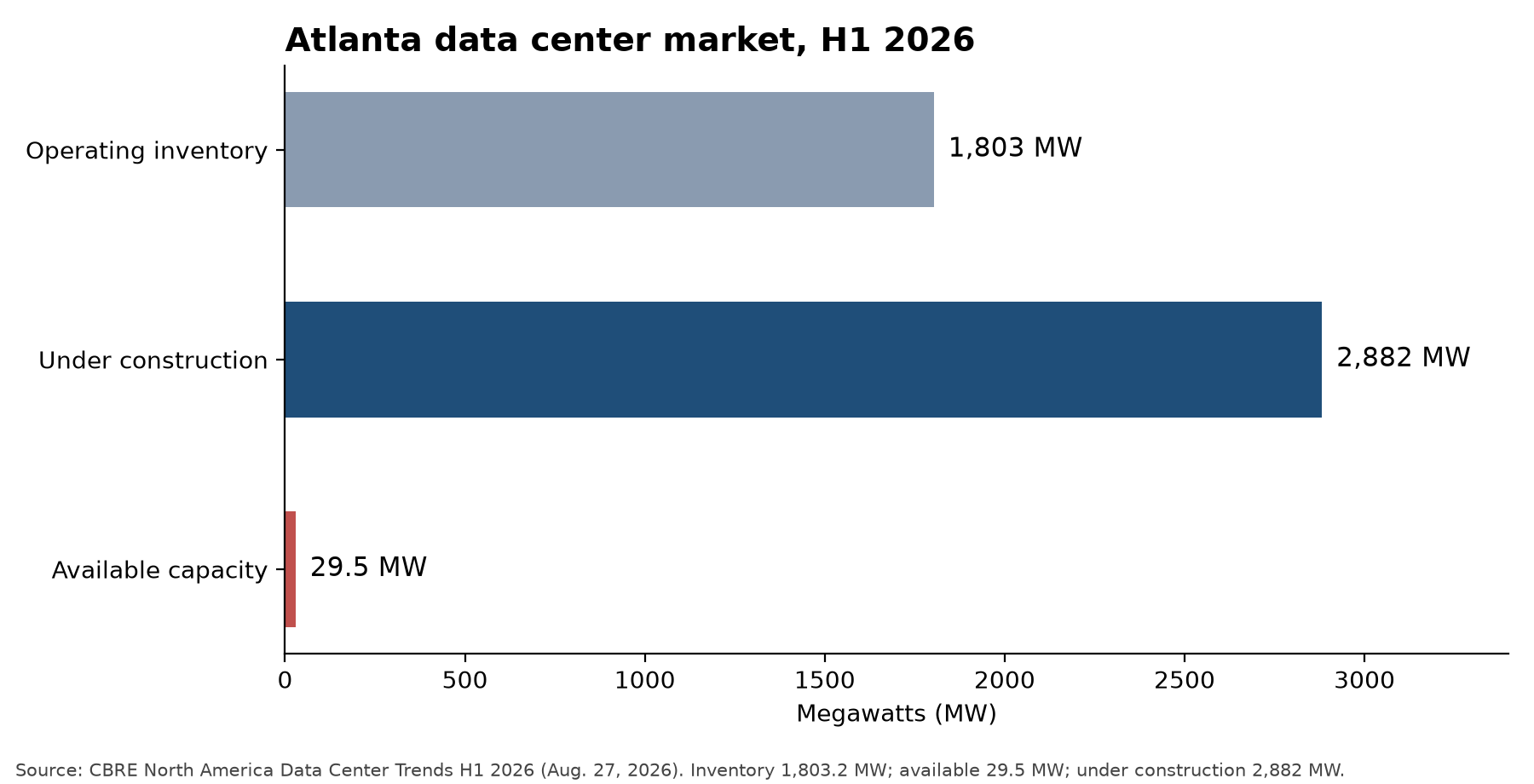
- Atlanta is now North America’s most active data center construction market, with 2,882 MW under construction in H1 2026, according to CBRE research summarized by Data Center Frontier.
- Building shells account for only about 9% to 14% of a $10 million to $13 million per MW development budget, while MEP accounts for more than 70%, according to Houlihan Lokey’s October 2026 data center update. Site and civil work is a fraction of that, but it controls when everything else can start.
- Georgia data center sites face a layered approval stack: local zoning and new data center ordinances, state Development of Regional Impact (DRI) review, NPDES construction stormwater coverage, state-water buffers, local stormwater ordinances and utility capacity commitments.
- A phased civil plan set lets owners start clearing, erosion control and mass grading early, protects future phases, and avoids re-grading, re-permitting and throwaway temporary work.
- The most expensive civil mistakes on data center sites are usually decisions made too late: pad elevations, earthwork balance, sediment basin locations, utility corridors and heavy-haul access.
Why Georgia is now a data center civil engineering market
Ten years ago, “data center site design in Georgia” was a niche topic. Today, it is one of the largest drivers of land development activity in the state. The numbers below come from the commercial real estate research firms and utilities that track the market most closely.
| Metric | Figure | Source |
|---|---|---|
| Atlanta capacity under construction, H1 2026 | 2,882 MW, up 52.3% year over year; first time Atlanta passed Northern Virginia | Data Center Frontier, citing CBRE |
| Atlanta operating inventory | 1,803.2 MW | CBRE press release, Aug. 27, 2026 |
| Atlanta available capacity | 29.5 MW | CBRE press release, Aug. 27, 2026 |
| Atlanta vacancy | 1%, second-tightest of CBRE’s 16 largest global markets | CBRE global press release, June 2026 |
| Atlanta absorption, first half of 2026 | Record 918 MW in six months | JLL, Aug. 11, 2026 |
| Atlanta preleasing lead time | Turnkey about 12 months before completion; build-to-suit about 2.5 years before completion | CBRE Atlanta market chapter |
| Georgia Power large-load pipeline | More than 68 GW of maximum potential 2032 large-load demand as of May 2026; over 80% still in early technical review | RMI |
| Average greenfield development cost | $17.6 million per MW for the most modern facilities, up 21% per MW since the prior report | Cushman & Wakefield 2026 Development Cost Guide |
| Data center supply-chain warehouse leasing, metro Atlanta | More than 9 million SF leased 2022 to 2025; 1.4 million SF in the first half of 2026 | Atlanta Journal-Constitution |
Three conclusions matter for anyone planning a data center site in Georgia.
First, demand is not the limiting factor. With 29.5 MW of available capacity against 2,882 MW under construction, almost everything being built in Atlanta is spoken for. CBRE reports that build-to-suit projects in Atlanta are preleasing roughly two and a half years before completion, which means the owner’s delivery date is often contractually fixed before the civil plans are finished.
Second, power is the gating item, and civil engineering is the next one. Cushman & Wakefield describes grid-connected power as increasingly scarce and says powered land commands significantly higher prices than non-powered land. Once power is secured, the next question is how quickly the site can be entitled, graded, drained and connected. That is a civil engineering question.
Third, the market is spreading out of the core. CBRE’s Atlanta chapter notes that developers have announced gigawatt-scale campuses across South Georgia and other rural markets, driven by transmission availability and lower entitlement risk. Rural and exurban sites typically bring larger earthwork volumes, longer utility extensions, more streams and wetlands, and less existing road infrastructure. All of that increases the civil scope.
Georgia’s major data center campuses: what they tell us about civil scope
Looking at the largest Georgia campuses shows the scale of site work involved. The table below references the operators’ own pages wherever possible, plus state filings and trade-press reporting. Figures are as published by each source and are not Mack Engineering project data.
| Campus / operator | Location | Published scale | Reference |
|---|---|---|---|
| QTS Atlanta 1 | Fulton County (Atlanta) | 99-acre campus with its own on-site Georgia Power substations | QTS Atlanta 1 |
| QTS Fayetteville campuses, including ATL2 East | Fayette County | ATL2 East DRI: about 2 million SF on about 313 acres, possible completion by 2029 | QTS Fayetteville; Data Center Dynamics |
| Microsoft Atlanta-area datacenter region | Fulton and Douglas counties | Announced as Microsoft’s next U.S. datacenter region | Microsoft Azure blog |
| Microsoft Floyd County campus | Rome, Floyd County | DRI filed Oct. 20, 2026: three buildings, up to 1,659,000 SF on 349 acres, completion estimated by 2032 | Data Center Dynamics |
| Meta Stanton Springs Data Center | Newton County | $2B+ investment; broke ground 2018; about 1,300 skilled trade workers at peak construction | Meta Stanton Springs fact sheet |
| Google Douglas County | Douglas County | First Georgia data center in 2007; new investments in LaGrange and Columbia County | Google Data Centers: Georgia |
| AWS Georgia investment | Butts and Douglas counties | At least $11 billion planned | About Amazon |
| Switch, The Keep | Metro Atlanta | Up to 150 MW, with a 2,000+ acre expansion campus | Switch Atlanta |
| DC BLOX Atlanta East | Rockdale County | 216 MW; 72 acres; 750,000 SF (tracker data) | Inside the Data Center Georgia directory |
| EdgeConneX Union City campus | Fulton County | 324 MW; 136 acres (tracker data) | Inside the Data Center Georgia directory |
| Project Sail (Prologis) | Coweta County | 830 acres; 9 buildings; 4.34 million SF; 910 MW at full buildout | Chattahoochee Riverkeeper fact sheet; Project Sail |
| Project Camellia (OpenAI) | Effingham County | 1,400 acres; four buildings totaling 4.4 million SF; 3,210 MW peak load in the DRI report | WTOC |
| Thor Equities, Kingston area | Bartow County | Proposed 150 MW, about $1 billion | Data Center Dynamics |
A running directory from Inside the Data Center counted 10 operating hyperscale campuses in Georgia, 13 under construction and 49 proposals as of September 2026, plus 11 withdrawn or rejected. The withdrawn and rejected list is worth noticing. In Georgia, entitlement risk is real, and civil engineering exhibits, stormwater narratives and traffic and utility information are often what local boards and neighbors scrutinize most.
What these campuses have in common from a civil standpoint:
- Large contiguous disturbed areas. Hundreds of acres disturbed in phases means erosion control is not a sheet in the plan set. It is a program that runs for years.
- Very large, very flat building pads. Data halls, electrical yards and generator yards want level or gently stepped pads, which drives cut-and-fill volumes on Piedmont terrain.
- Substations and utility interconnection on site. QTS describes on-site Georgia Power substations at Atlanta 1. Substation pads, transmission line corridors and access roads are civil scope.
- Heavy, sensitive deliveries. Large power transformers, generators and switchgear require roads, turning movements and pavement sections designed for them.
- Water and sewer demand that varies by cooling design. Project Sail’s fact sheet estimates 300,000 gallons per day at full buildout, while the Project Camellia DRI report estimates about 30,000 gallons per day with closed-loop cooling. That is a tenfold difference in civil utility sizing, and it is decided by the mechanical design.
Where civil engineering fits in data center cost and schedule
Owners often ask why they should care so much about the civil engineer when the building is where the money goes. The data answers that question both ways.
On cost, the civil scope is modest. Houlihan Lokey puts a typical development budget at about $10 million to $13 million per MW, with the building shell at only 9% to 14% and MEP at 70% or more. Cushman & Wakefield reports an average greenfield cost of $17.6 million per MW for the most modern facilities. As simple arithmetic, a 100 MW campus at that average implies roughly $1.76 billion in development cost. Site work is a small slice of that number.
On schedule, the civil scope is decisive. Nothing vertical happens until the site has a land disturbance permit, erosion control is installed, pads are graded and certified, and construction access works. Substation pads must be ready when the utility is ready. Water, sewer and fire service must be in place before certificates of occupancy. When a build-to-suit tenant has signed a lease 2.5 years before completion, a civil delay is a delay on a very expensive asset.
That is the core idea behind cost-effective data center civil engineering: spend design effort where it shortens the critical path and avoids rework, and avoid gold-plating the parts of the site that do not control the schedule.
Mack perspective: Mack Engineering is owned by a licensed general contractor, so our civil design is filtered through field constructability: how the grading will actually be phased, where the trucks will actually go, and what the sediment basins will look like after a Georgia thunderstorm. Plans are sealed by the responsible engineer of record. Learn more about our land development engineering services.
The Georgia approval stack for data center sites
Before getting into design methods, it helps to map the approvals a Georgia data center site typically has to clear. Each one shapes what goes into the civil plan set and when.
Local zoning and new data center ordinances
Georgia jurisdictions are writing data center rules quickly. According to Thompson Hine, the Georgia Tech Energy Policy and Innovation Center (EPIcenter) reports that approximately one in five Georgia counties has adopted a data center ordinance or is developing one, and at least 12 Georgia jurisdictions have adopted temporary moratoriums. The same analysis notes that 100-foot setbacks adjacent to residential property are becoming increasingly common in some jurisdictions.
Georgia Tech’s Georgia Data Center Ordinance Hub reviewed municipal codes for about 180 Georgia cities and counties and organizes ordinance topics into site planning and building design, infrastructure and utilities, environmental and community protections, public safety and security, and lifecycle governance. Several of those are civil engineering topics directly. The EPIcenter data center dashboard is a useful starting point for any site.
Closer to Mack’s home market, Cherokee County adopted a 30-day data center moratorium on July 21, 2026, with the stated intention of extending it into early 2027 while staff draft an ordinance. The county reported no pending data center applications at the time. In the City of Atlanta, a proposal reported by WSB Radio in August 2026 would require data centers served by the city water system to transition to closed-loop cooling and would prohibit routine use of drinking water for cooling.
Civil takeaway: confirm the current ordinance and moratorium status in writing before you buy, and lay out setbacks, buffers, berms, screening, noise mitigation areas and security perimeters at the concept stage. These features consume land and change the earthwork balance.
Developments of Regional Impact (DRI)
In November 2025, the Georgia Department of Community Affairs board added a “technological facilities” category to the DRI rules that explicitly covers data centers. As reported by The Current GA, data centers of at least 500,000 square feet trigger DRI review outside the Atlanta region, while inside the Atlanta Regional Commission’s territory the threshold is 300,000 square feet in urban and suburban areas. Developers must make plans public, including estimates of water and electricity use. DRI review does not approve or deny a project; that remains a local decision. See the DCA Developments of Regional Impact page for the current rules.
Civil takeaway: a DRI submittal needs credible site, access, water and sewer numbers early. The civil engineer should be producing the concept plan, utility demand assumptions and traffic access concept that feed the DRI, not reacting to them later.
NPDES construction stormwater coverage
Georgia EPD’s three construction stormwater general permits are in effect: GAR100001 for stand-alone construction, GAR100002 for infrastructure construction and GAR100003 for common development construction. According to Georgia EPD, they authorize discharges through July 31, 2028. Choosing the right permit, and setting up the campus so that future phases are covered correctly, is a phasing decision. Our guide to Georgia’s NPDES construction stormwater permits explains the permit structure in more detail.
Erosion, sediment and pollution control
Erosion and sediment control plans in Georgia follow the Georgia Soil and Water Conservation Commission’s Manual for Erosion and Sediment Control in Georgia (the Green Book). On a data center site, the ES&PC plan is the most important document in the early-works package, because it governs how much of the site can be open at once and where sediment storage goes.
State-water buffers and stream or wetland impacts
Georgia’s Erosion and Sedimentation Act requires a 25-foot undisturbed buffer on warm-water streams and a 50-foot buffer on designated trout waters, measured from the point of wrested vegetation, as summarized in GDOT’s buffer variance guidance. Encroachments require a variance from EPD. Stream and wetland fills also involve U.S. Army Corps of Engineers Section 404 permitting and an EPD Section 401 water quality certification, as Georgia EPD explains in its response to comments on the ATL3 Pippin data center project. Large flat pads on rolling Georgia land often collide with streams, so this is frequently the longest-lead environmental item.
Post-construction stormwater
Post-construction stormwater design in Georgia is built around the Georgia Stormwater Management Manual (the Blue Book), maintained by the Atlanta Regional Commission. The ARC notes that MS4 permittees have been required since January 2, 2017, to use the 2016 edition or an equivalent manual, outside the coastal area. Requirements typically include runoff reduction or water quality treatment, channel protection, overbank flood protection and extreme flood analysis. Large roofs and paved yards make stormwater one of the biggest land users on a data center site. Our detention pond design guide covers sizing and cost drivers.
Land disturbance permit review timelines
Georgia’s SB 447 put new deadlines on land disturbance permit review. For a phased campus where every month matters, it is worth understanding how those deadlines work and what triggers them. See our explainer on the Georgia SB 447 land disturbance permit 45-day deadline.
Water, sewer and power commitments
Water supply works differently depending on the source. According to Georgia EPD as reported by The Macon Telegraph, a data center that connects to a city water system is treated as a municipal customer and does not need its own water permit, while a company withdrawing directly from a river or reservoir must apply to EPD for an industrial withdrawal permit. The same reporting notes that only 16 of 30 data centers planned around the Ocmulgee basin disclosed projected water use through DRI review.
On power, the Georgia Public Service Commission’s data center fact sheet summarizes the 2025 rule that allows Georgia Power to use minimum billing and longer contract terms for new large-load customers, and requires new data center contracts to be provided to the PSC at least 30 days before execution. Power contracts are not civil engineering, but the substation location, transmission corridor and the timing of the utility’s site requirements are.
Civil takeaway: get written water and sewer capacity letters, fire flow test data and the utility’s substation site requirements before finalizing the site layout. These items move pads.
Lessons from Georgia sites: erosion control is a reputation issue
Two recent Georgia disputes show why erosion and sediment control deserves senior attention on data center projects. The following are allegations reported in the press, not findings.
- In Fayette County, residents and the Flint Riverkeeper announced plans to sue over alleged repeated discharges of sediment-filled stormwater from QTS data center construction that began in 2023, reaching adjacent property, a Sandy Creek tributary and nearby wetlands, according to the Times-Herald.
- Near Meta’s Stanton Springs Data Center, four families filed a lawsuit alleging that blasting, excavation and land clearing allowed sediment to enter the aquifer that supplies their wells, as reported by WSB-TV. Meta acknowledged “limited blasting” about 1.1 miles from one family’s property, according to the report.
Opponents of other projects cite these disputes. The Chattahoochee Riverkeeper’s Project Sail fact sheet references a Fayetteville campus that has struggled with soil erosion. In other words, erosion problems on one site can become entitlement problems on the next.
Practical civil responses that cost little relative to the risk:
- Limit open, unstabilized area by phase, and sequence clearing so the sediment basins are built and stabilized before mass grading begins upstream of them.
- Size sediment storage and outlet structures for the realistic disturbed drainage area of each phase, not only the final condition.
- Plan for flocculant use, turbidity sampling locations and inspection access from the start, rather than adding them after the first storm.
- Where rock blasting or deep excavation is expected near private wells, consider documenting baseline well conditions before work begins, in coordination with the owner’s counsel and geotechnical engineer.
- Keep stabilization (temporary seeding, mulch, matting) in the contract as a measurable pay item, not an afterthought.
Cost-effective civil engineering methods for data centers
These are the design methods that have the most leverage on data center site cost and schedule. None of them is exotic. What makes them cost-effective is making these decisions early, while they are still cheap to change.
1. Start with a site feasibility screen that tests the deal-killers
A data center feasibility study should answer, in order: Can we get power here, and where would the substation go? Is there adequate water and sewer, or a feasible on-site alternative? What does zoning allow today, and is there a moratorium or new ordinance? Where are the streams, wetlands, floodplain and buffers? What does the topography and geology imply for earthwork and rock? Can heavy-haul vehicles physically reach the site? Our feasibility reports and due diligence engineering services are built around these questions.
The cost-effective part is order. If power or water fails, there is no reason to spend money on detailed topographic surveys or traffic studies yet.
2. Treat pad elevations and earthwork balance as the first design decision
On Piedmont terrain, the finished floor elevation of each building and yard drives cost more than almost anything else on the civil sheets. The goals are:
- Balance cut and fill across the campus where practical, so soil does not have to be imported or hauled off.
- Use stepped pads (data hall, electrical yard, generator yard and parking at different elevations) instead of forcing one elevation across a large footprint.
- Use geotechnical borings concentrated in deep cut areas, deep fill areas and proposed retaining wall locations, so rock and unsuitable soils are found before bidding, not during mass grading.
- Design the first phase to place surplus fill on future pads instead of hauling it away, then account for settlement and compaction testing in that strategy.
- Minimize retaining walls. Tall walls are expensive and slow; a few feet of pad elevation change can sometimes eliminate them.
Revit and 3D civil models are very effective here. Running earthwork scenarios in a model is cheaper than discovering a 300,000-cubic-yard imbalance in bids. See how we use Revit and BIM for civil site design.
3. Design stormwater as a campus system, not building by building
Data centers create large roofs, large paved equipment yards and large drives, so the post-construction stormwater footprint can be substantial. Cost-effective methods include:
- Regional or shared ponds sized for the full campus build-out, with phased outlet structures, instead of a separate pond for every building.
- Sediment basins located where permanent detention ponds will go, so the temporary basin can be converted to the permanent pond and the excavation is done once.
- Runoff reduction from roof drainage, bioretention in parking and landscape areas, and preserved vegetated buffers that double as ordinance-required screening.
- Conveyance sized for the final condition at the outset when the cost difference is small, to avoid replacing pipes under live operations.
- Early coordination with the jurisdiction’s stormwater reviewer on how phased compliance will be documented.
4. Reserve utility corridors before anything else is drawn
Duct banks, water mains, fire loops, sewer, reclaimed or process water, fiber and gas all compete for the same space between buildings, yards and roads. Once a building is placed in the wrong spot, corridors get crowded and expensive. A cost-effective layout:
- Defines dedicated corridors with separation between electrical duct banks and wet utilities.
- Keeps the corridor out from under future pads so later buildings do not require relocation of live utilities.
- Allows two independent feeds where redundancy is part of the design criteria.
- Provides a looped fire main with hydrant spacing and fire flow that the fire marshal will accept, based on actual hydrant flow test data.
5. Design for heavy-haul delivery and construction traffic
Large power transformers are among the heaviest loads on public roads. BlackForge Data Centers’ site guide notes that transformers weighing roughly 100 to 400 tons have to reach the site and recommends checking bridges, turns and clearances on the route early. On site, the civil engineer should:
- Lay out at least one entrance and internal route designed for the heavy-haul vehicle and turning movements.
- Design pavement sections and subgrade for transformer and crane loads where they will travel, and use lighter sections where they will not.
- Provide crane pads and laydown areas that work for each phase.
- Separate construction traffic from operating traffic for future phases, especially at security gates.
6. Coordinate the substation and electrical yards early
The utility, not the owner’s design team, usually controls substation requirements. The civil design must accommodate the substation pad, grounding, drainage, access road, transmission line corridor and any utility-owned property lines or easements. If the utility’s requirements arrive late, they can move pads and roads. Ask for them early and lay out the site so the substation can move within a defined zone without re-grading the campus.
7. Size water and sewer around the actual cooling design
As noted above, published Georgia filings range from about 30,000 to about 300,000 gallons per day for very large campuses, depending on cooling design. The civil engineer needs firm demand and discharge numbers from the mechanical engineer before sizing services, meters, backflow, sewer laterals, lift stations or pretreatment. Where the jurisdiction is moving toward closed-loop requirements, as proposed in Atlanta, the design should anticipate that.
8. Plan security and ordinance features as part of the grading
Perimeter fencing, vehicle barriers, berms, landscaped buffers, noise walls and lighting limits are increasingly ordinance-driven. Incorporating berms into the earthwork balance can turn surplus soil into required screening, which is often cheaper than hauling it off site.
Cost lever summary
| Decision | Why it controls cost | When to decide |
|---|---|---|
| Pad elevations and stepped layout | Drives cut and fill, rock, import/export and retaining walls | Concept plan, before DRI or rezoning exhibits |
| Sediment basin locations | Basins placed at permanent pond sites avoid double excavation | Early-works ES&PC plan |
| Campus stormwater strategy | Shared ponds can reduce land use and duplicate structures | Concept plan, confirmed in early works |
| Utility corridors | Avoids relocating live utilities for future buildings | Before building footprints are fixed |
| Heavy-haul route and pavement sections | Avoids rebuilding roads damaged by transformer or crane loads | Before the backbone package |
| Substation zone | Utility requirements can move pads and roads if they arrive late | At power application, before early works |
| Water and sewer sizing | Cooling design can change demand by an order of magnitude | Before backbone utility design |
| Ordinance features (setbacks, berms, screening) | Consumes land and can absorb surplus fill | Before land purchase and concept plan |
How to phase the civil plan set for cost-effective delivery
This is where data center projects most often win or lose time. A single, complete civil plan set for an entire campus forces the owner to wait for every design decision before any land disturbance is permitted. A phased civil plan set breaks the work into permit packages that can be designed, reviewed and constructed in sequence, with each one built to support the next.
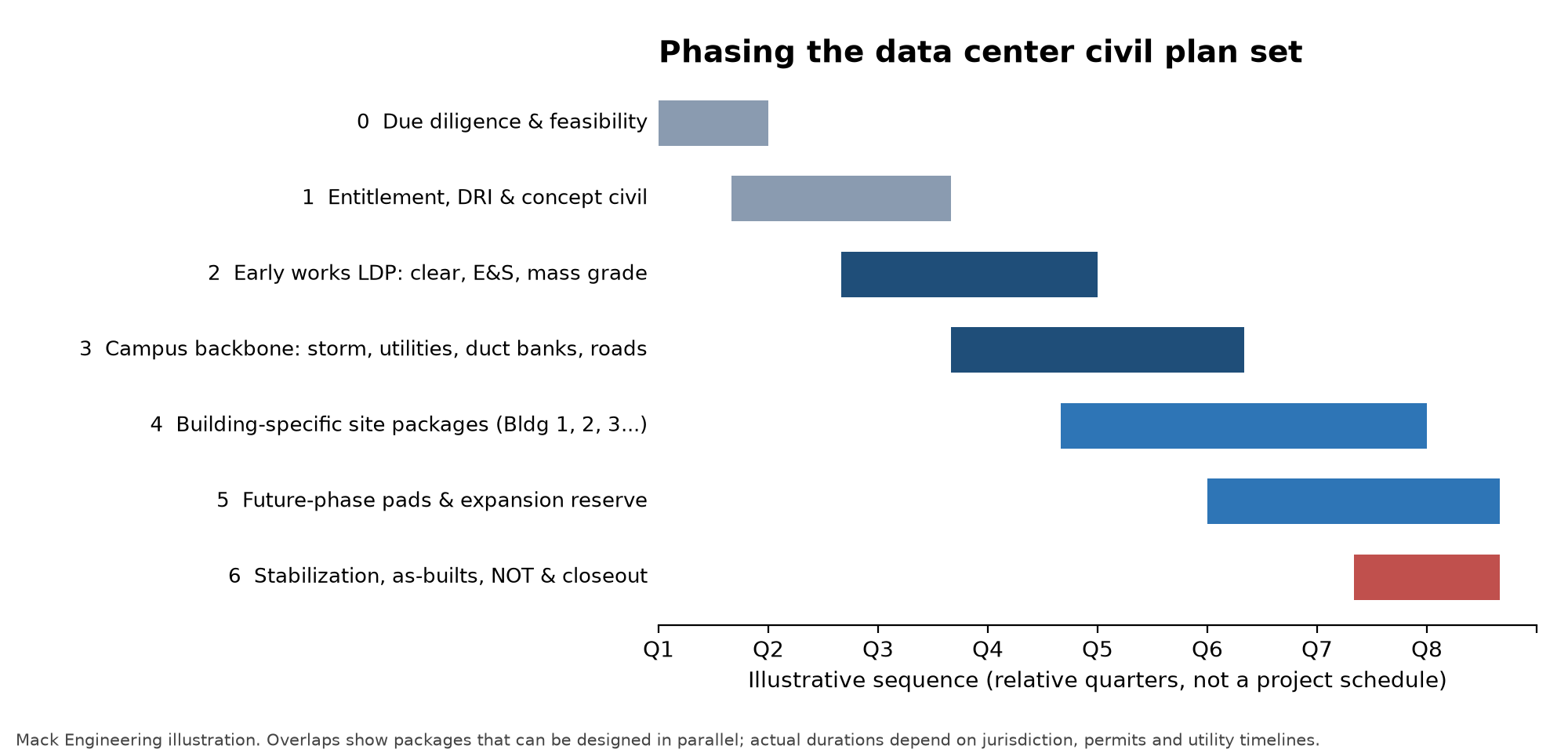
Phase 0: Due diligence and feasibility
Deliverables: feasibility report, site limits map, utility availability summary, preliminary earthwork assessment, permitting roadmap, rough-order-of-magnitude site cost. This phase decides whether the site moves forward and should be completed before closing whenever possible. See what goes into a site feasibility report.
Phase 1: Entitlement, DRI and concept civil
Deliverables: concept site plan with buildings, yards, substation zone, ponds, corridors and access; zoning and DRI exhibits; utility demand assumptions; preliminary stormwater narrative; traffic access concept. The concept plan should already reflect the earthwork balance and phasing so that what is promised at hearings is what gets built. Our article on zoning exhibit requirements for metro Atlanta rezonings explains how these exhibits are reviewed.
Phase 2: Early-works land disturbance package
Deliverables: clearing and grubbing limits, phased ES&PC plan, sediment basins, construction entrances, haul roads, mass grading plan, temporary stream crossings where permitted, and NPDES coverage. The purpose is to get earthwork moving while backbone and building design continue. To make this phase cost-effective:
- Include the sediment basins that will become permanent ponds, built to their permanent excavation geometry when practical.
- Grade to rough subgrade with tolerances that do not require re-grading in later phases.
- Show the phases of erosion control clearly so inspectors and contractors can follow them.
- Avoid installing anything that the next package will rip out.
Phase 3: Campus backbone package
Deliverables: main roads and heavy-haul route, storm trunk lines and permanent ponds, water mains and fire loop, sanitary sewer and any lift stations, duct-bank and fiber corridors, and the substation site work coordinated with the utility. The backbone serves every building, so it is designed for the full build-out but constructed in segments that match building phases.
Phase 4: Building-specific site packages
Deliverables for each building: final pad grading, building utility connections, equipment and generator yard grading and paving, parking, local storm drainage, sidewalks, site lighting, fencing and landscaping. Packaging per building lets the first building move to vertical construction and certificate of occupancy without waiting for the second building’s design.
Phase 5: Future-phase pads and expansion reserve
Deliverables: stabilized future pads, stubbed utilities, reserved corridors and documented stormwater capacity for future buildings. When the next tenant signs, the expansion design starts from a known pad, known utilities and known permit history.
Phase 6: Stabilization, as-builts and closeout
Deliverables: final stabilization, as-built surveys, pond certifications, bond releases, utility acceptance, and a Notice of Termination where appropriate. Closeout is often neglected on large sites, and incomplete closeout can delay bond releases and future permits.
Phasing summary table
| Package | Main contents | Typical approvals | Cost risk it removes |
|---|---|---|---|
| 0 Due diligence | Site limits, utilities, earthwork, permits | None (pre-purchase) | Buying a site that cannot be powered, drained or served |
| 1 Entitlement and concept | Concept civil, DRI and zoning exhibits | Rezoning or use permit; DRI review if thresholds are met | Promising a layout that cannot be built economically |
| 2 Early works | Clearing, ES&PC, basins, mass grading | LDP; NPDES coverage; buffer variances or 404/401 where needed | Waiting for full design before earthwork starts |
| 3 Backbone | Roads, storm trunks, ponds, water, sewer, duct banks | LDP revision or separate permit; utility approvals | Relocating live utilities and rebuilding roads |
| 4 Building sites | Pads, yards, parking, connections | Site permit tied to building permit | Holding Building 1 for Building 2’s design |
| 5 Expansion reserve | Future pads, stubs, reserved capacity | Documented in prior approvals | Re-permitting and re-grading for later phases |
| 6 Closeout | Stabilization, as-builts, certifications | Bond release; Notice of Termination; utility acceptance | Held bonds and blocked future permits |
Common phasing mistakes
- Permitting the early-works package without a defined backbone layout, which forces corridors to be redesigned around already-graded pads.
- Sizing temporary sediment basins only for the first phase, then having to rebuild them as the disturbed area grows.
- Leaving future pads unstabilized, which extends erosion control maintenance costs for years.
- Splitting packages so finely that the jurisdiction treats each one as a new submittal with a new review clock and new fees.
- Assuming a utility will meet the schedule without written requirements and dates.
- Treating closeout as optional until a bond or permit is held.
Owner tip: Ask the local plan reviewer at the pre-application meeting how they prefer phased packages to be submitted, how they track common development across phases, and whether early-works grading can be permitted ahead of final building approvals. Answers differ by jurisdiction, and they should shape the package boundaries.
Aligning the civil plan set with procurement and construction
The phasing strategy should match the way the site will be bought and built. Owner-side construction management that understands civil sequencing can keep packages aligned with bid packages, long-lead materials and site contractor mobilization. Practical alignments include:
- Bid early works as a stand-alone grading and erosion control contract, with unit prices for rock and unsuitable soils based on the geotechnical report.
- Order long-lead site materials such as large-diameter storm pipe, precast structures and duct-bank materials from the backbone design before it is fully permitted, where the owner accepts that risk.
- Use the same survey control and model across all packages so as-builts from each phase feed the next design.
- Hold weekly coordination between civil, MEP, the utility and the site contractor during backbone construction, because that is where conflicts appear.
Read more about owner’s-side construction management for Georgia commercial projects and our construction management services.
How Mack Engineering helps data center owners and developers in Georgia
Mack Engineering is an Alpharetta-based civil engineering firm serving metro Atlanta and North Georgia. Our approach to data center and other mission-critical sites draws on the same commercial and industrial land development disciplines we use every day:
- Feasibility reports and due diligence engineering that test power, water, sewer, zoning, environmental and earthwork deal-killers before you commit.
- Site planning and concept civil that support rezonings, use permits and DRI submittals.
- Land development engineering, including mass grading, erosion control and phased land disturbance packages.
- Stormwater design and hydrology studies and stormwater permitting and compliance.
- Permit application management and zoning and land use planning.
- Revit modeling and BIM coordination for earthwork scenarios and utility coordination.
- Construction management that keeps phased packages, bids and field work aligned.
Because Mack Engineering is owned by a licensed general contractor, we design with constructability in mind. Our sister company, Mack Development Group, provides general contracting and construction services, which gives our engineers direct feedback from the field. If your project also includes warehouse, flex or supporting industrial buildings, see our guide to industrial site development for warehouse and flex projects in metro Atlanta and our commercial land development engineer hiring guide.
Frequently asked questions
A civil engineer designs everything outside the building: site feasibility, grading and building pads, erosion and sediment control, stormwater management, water, sewer and fire service, roads and heavy-haul access, parking, substation and equipment yard site work, and the permit drawings for the land disturbance permit and NPDES coverage. The civil engineer also supports zoning and DRI submittals with concept plans and utility information.
It is a small share. Houlihan Lokey estimates a total development budget of about $10 million to $13 million per MW, with building shells at 9% to 14% and MEP at more than 70%. Site and civil costs vary widely with terrain, rock, utility extensions and stormwater, so they should be estimated from a site-specific feasibility study rather than a rule of thumb.
Often, yes. DCA’s rules include a technological facilities category for data centers. Outside the Atlanta region, the threshold is 500,000 square feet. Inside the Atlanta Regional Commission area, the threshold is 300,000 square feet in urban and suburban areas and 500,000 square feet in rural areas. DRI review is advisory; local governments make the approval decision.
A phased civil plan set divides the site design into separate permit packages, such as early works (clearing, erosion control and mass grading), campus backbone (roads, storm, water, sewer and duct banks) and building-specific packages. Each package can be permitted and built while the next one is being finished, which shortens the time to vertical construction.
In many Georgia jurisdictions, yes, through an early-works land disturbance permit with an approved ES&PC plan and NPDES coverage. Whether and how this is allowed depends on the jurisdiction, so confirm it at a pre-application meeting.
It depends heavily on cooling design. Published Georgia filings range from about 30,000 gallons per day for the closed-loop Project Camellia design to about 300,000 gallons per day for Project Sail at full buildout. The civil engineer sizes water and sewer services from the mechanical engineer’s actual demand and discharge numbers.
Yes. At least 12 Georgia jurisdictions have adopted temporary moratoriums, according to Thompson Hine, and roughly one in five counties has adopted or is developing a data center ordinance, according to Georgia Tech EPIcenter data. Cherokee County adopted a moratorium in July 2026. Always confirm current status before purchasing land.
State law requires a 25-foot undisturbed buffer on warm-water streams and a 50-foot buffer on designated trout waters, measured from the point of wrested vegetation. Many local governments add their own larger buffers. Encroachments require an EPD buffer variance, and stream or wetland fills may also need federal Section 404 and state Section 401 approvals.
Set pad elevations early, use stepped pads instead of one large flat pad, balance cut and fill across the campus, investigate rock and unsuitable soil with targeted geotechnical borings, place surplus fill on future pads or ordinance-required berms, and minimize tall retaining walls.
Talk to a Georgia data center civil engineer
Whether you are screening a site, preparing a rezoning or DRI submittal, or need a phased civil plan set that gets your first building moving sooner, Mack Engineering can help. Call (770) 715-7295 or contact Mack Engineering to schedule a feasibility conversation. Our office is at 5745 Stables Wy A-09, Alpharetta, GA 30004, and we serve metro Atlanta and North Georgia.
For other large and small commercial parcels, see commercial site development and warehouse and flex site development.
Related reading
- Civil Engineering for Land Development in Atlanta, GA
- Feasibility Studies and Reports
- Due Diligence Engineering in Atlanta, GA
- Site Feasibility Report Before You Buy Land in Metro Atlanta
- Hiring a Commercial Land Development Engineer in Atlanta
- Industrial Site Development in Metro Atlanta: Permits and Zoning for Warehouse and Flex
- Zoning Exhibit Requirements in Metro Atlanta: What a Good Rezoning Submittal Looks Like
- Georgia NPDES Construction Stormwater Permits (2023 Reissuance)
- Detention Pond Design in Metro Atlanta: GSMM Sizing and Cost
- Georgia SB 447 Explained: The 45-Day Land Disturbance Permit Deadline
- Revit and BIM for Civil Site Design in Georgia
- Owner’s-Side Construction Management for Georgia Commercial Projects
Sources
- CBRE, North America Data Center Trends H1 2026 (press release, Aug. 27, 2026)
- CBRE, Atlanta data center market chapter, H1 2026
- CBRE, global data center supply press release, June 2026
- Data Center Frontier, CBRE: record data center construction fails to ease capacity crunch
- JLL, data center demand exceeds expectations in H1 2026
- Cushman & Wakefield, 2026 Data Center Development Cost Guide
- Houlihan Lokey, Real Estate Data Center Update, October 2026 (PDF)
- RMI, planners have tools to manage large-load forecast uncertainty
- Georgia Public Service Commission, data center fact sheet, September 2026 (PDF)
- Atlanta Journal-Constitution, companies tied to data centers lease record amount of Atlanta warehouse space
- QTS, Atlanta 1 data center
- QTS, Fayetteville data centers
- Microsoft Azure blog, next U.S. datacenter region in Fulton and Douglas counties
- Meta, Stanton Springs Data Center fact sheet (PDF)
- Google Data Centers, Georgia
- About Amazon, AWS investment in Georgia
- Switch, Atlanta campus
- Project Sail, Coweta County
- Inside the Data Center, Georgia data centers directory
- Data Center Dynamics, QTS files to expand Fayetteville campus
- Data Center Dynamics, Microsoft files for data center campus in Floyd County
- Data Center Dynamics, Thor Equities submits plans for 150 MW data center in Georgia
- WTOC, state reveals full DRI report for OpenAI data center project
- Chattahoochee Riverkeeper, Project Sail fact sheet, March 2026 (PDF)
- Thompson Hine, Freeze, study, regulate, repeat: Georgia’s data center cycle
- Georgia Tech EPIcenter, data center dashboard
- Georgia Tech Research News, EPIcenter launches Georgia Data Center Ordinance Hub
- Georgia Department of Community Affairs, Developments of Regional Impact
- The Current GA, Georgia board approves new review process for large data centers
- Georgia EPD, NPDES construction stormwater permits
- Georgia Soil and Water Conservation Commission, technical guidance (Green Book)
- Atlanta Regional Commission, Georgia Stormwater Management Manual
- GDOT, buffer variance guidance (PDF)
- Georgia EPD, ATL3 Pippin Section 401 response to comments
- Cherokee County, data center moratorium announcement
- WSB Radio, new requirements for data centers in Atlanta being discussed
- The Macon Telegraph, data center water use in the Ocmulgee basin
- Times-Herald, Flint Riverkeeper and Fayetteville residents plan to file lawsuit
- WSB-TV, four Georgia families sue Meta over well water
- BlackForge Data Centers, site access, shape and frontage guide
This article is general information about civil engineering and permitting for data center sites in Georgia. It is not a parcel-specific permit determination, legal advice, or a cost estimate. Requirements vary by jurisdiction and change frequently; confirm current rules with the reviewing agencies and your engineer of record.