
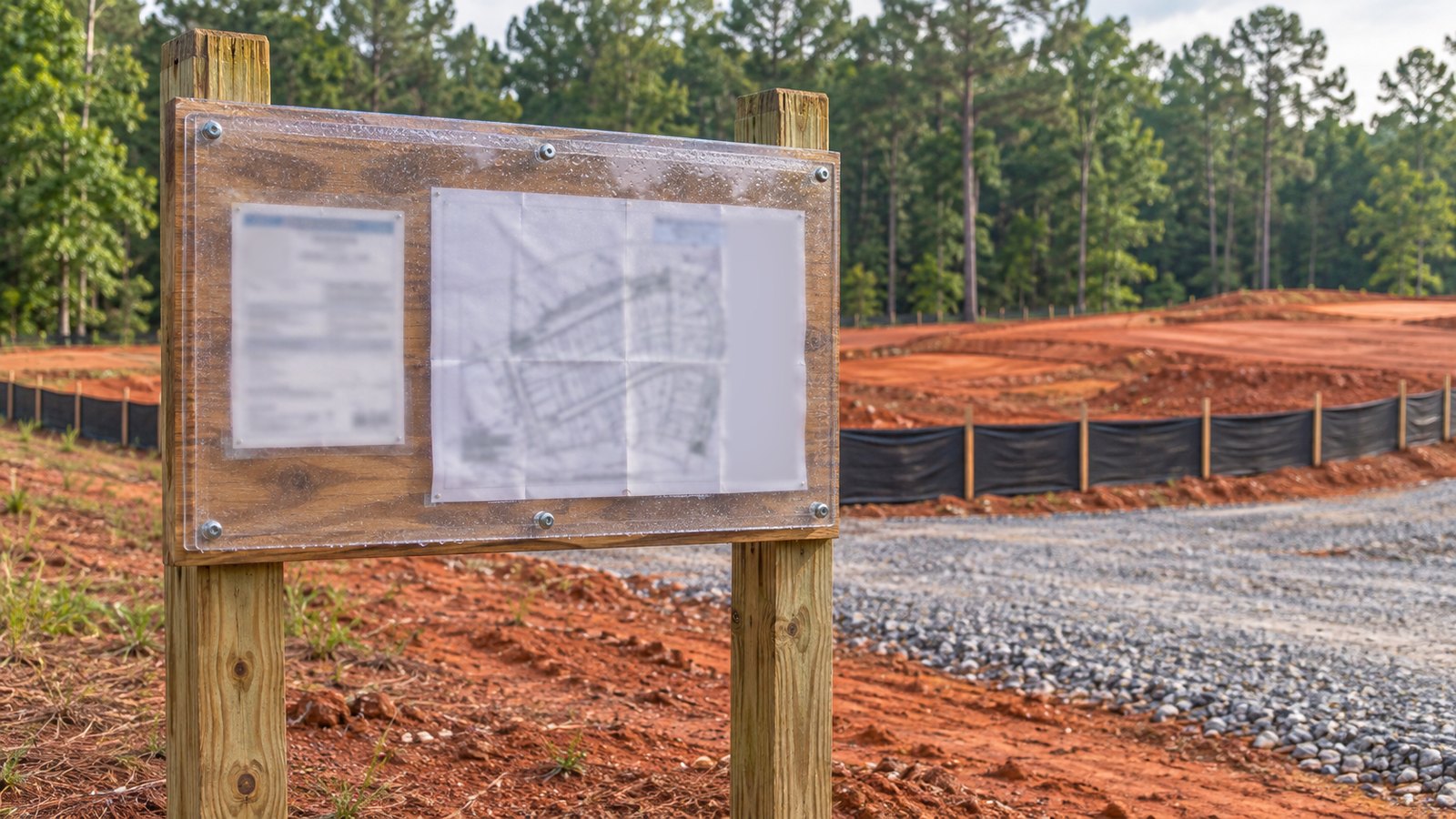
How do you read a land disturbance permit in Georgia? Start with the permit itself: the permit number, the issuing authority, the permittee and 24-hour contact, the total and disturbed acreage, the issue and expiration dates, and any special conditions. Then read the approved erosion, sedimentation and pollution control (ES&PC) plan, because in Georgia that plan is part of the permit[17]. It shows the limits of disturbance for each phase, the stream buffers, every erosion control practice and when it goes in[15]. The rules come from the Georgia Erosion and Sedimentation Act of 1975, and the details vary by city and county[2].
Key Takeaways
- The plan is the permit. The approved ES&PC plan is part of the permit, so violating the plan violates the permit[17][18].
- Two permits, two agencies. The LDP comes from the local issuing authority; coverage under EPD’s construction stormwater general permit comes from a notice of intent filed with Georgia EPD[2][11].
- Nothing moves before the pre-construction meeting. Many jurisdictions require an on-site inspector meeting before any disturbance[20][25].
- The first BMPs get a 7-day check. On NPDES sites, the plan’s design professional must inspect the initial sediment storage and perimeter controls within 7 days after installation[11].
- Failed BMPs are daily violations. Each day BMPs are not properly designed, installed or maintained is a separate violation[5].
- Expiration is local. Terms range from 60-day start deadlines to 18-month permits, so read your own dates and renewal rules[24][25].
What a Land Disturbance Permit Is and Who Issues It
Georgia law defines land-disturbing activity as any activity that may move soil or sediment into state waters or onto land, including clearing, grading, excavating and filling[1]. Unless exempt, it requires a permit from a local issuing authority or a notice of intent to EPD[2]. Depending on the jurisdiction, the permit may be called an LDP, a land disturbing activity (LDA) permit, or a development or grading permit[17][25].
Local issuing authority. In a certified jurisdiction, the county issues permits outside city limits, the city inside its limits, and some water and sewer authorities in their service areas. The issuer inspects and enforces its permits. Where a jurisdiction is not certified, EPD enforces the state general permit instead[2].
GSWCC plan review. No permit can be issued until the erosion control plan is approved by the soil and water conservation district or a certified local authority with a review agreement[2]. Districts have 35 days to act[4]. Plans must include the Georgia Soil and Water Conservation Commission (GSWCC) checklist in effect on January 1 of the permit year[15] and meet the Manual for Erosion and Sediment Control in Georgia, the Green Book[5][16].
NPDES notice of intent. EPD’s construction stormwater general permits cover stand alone sites (GAR100001), infrastructure (GAR100002) and common developments such as subdivisions (GAR100003)[12], reissued effective August 1, 2023[10]. The notice of intent (NOI) is filed through EPD’s GEOS system[13] at least 14 days before construction, with a copy to the local issuing authority[11]. See our post on the 2023 reissuance of Georgia’s NPDES construction stormwater permits.
What Each Part of the Permit Means
Forms differ by jurisdiction, but these items appear on real Georgia permits and applications. Anything not on the permit card is usually on the approved plan cover sheet.
| Permit item | What it tells you | What to check |
|---|---|---|
| Permit number | The tracking number, such as the “LDA Permit #” on Macon-Bibb’s form[17] | Use it on inspection requests and revisions |
| Issuing authority | The certified county, city or authority that issued the permit and inspects the site[2] | It matches the jurisdiction where the land sits |
| Permit type | Stand alone, common development or infrastructure; residential, commercial or subdivision[18][20] | Each type has its own GSWCC checklist and NPDES permit[12][15] |
| Permittee, owner and operator | Who is responsible for the work[17][18] | Names match the NOI and current contractor |
| 24-hour contact | The person responsible for erosion and pollution controls around the clock[15][18] | Name and phone number are current |
| Total and disturbed acreage | Project area and area actually disturbed[15][18] | Per-acre fees are based on disturbed acreage[2] |
| Limits of disturbance | The allowed disturbance boundary for each phase[15] | Disturbance outside it is not covered by the plan |
| NOI status | Primary, secondary or tertiary permittee and the date the NOI went to EPD[18] | Proof of NOI submittal is kept on site[11] |
| Certified personnel | Name, number and expiration of the GSWCC-certified person[19] | Certifications expire within three years[9] |
| Issue date and expiration | When the permit took effect and when it lapses[17][18] | Start deadlines and work-stoppage limits |
| Conditions and bond | “Approved w/Conditions,” special conditions and any erosion control bond[18] | Bonds are capped at $3,000 per acre and can be called to stabilize a site[2] |
| Approved plan | The ES&PC plan, which is part of the permit[17] | A stamped set is kept on site[21][23] |
How to Read the Approved ES&PC Plan Sheets
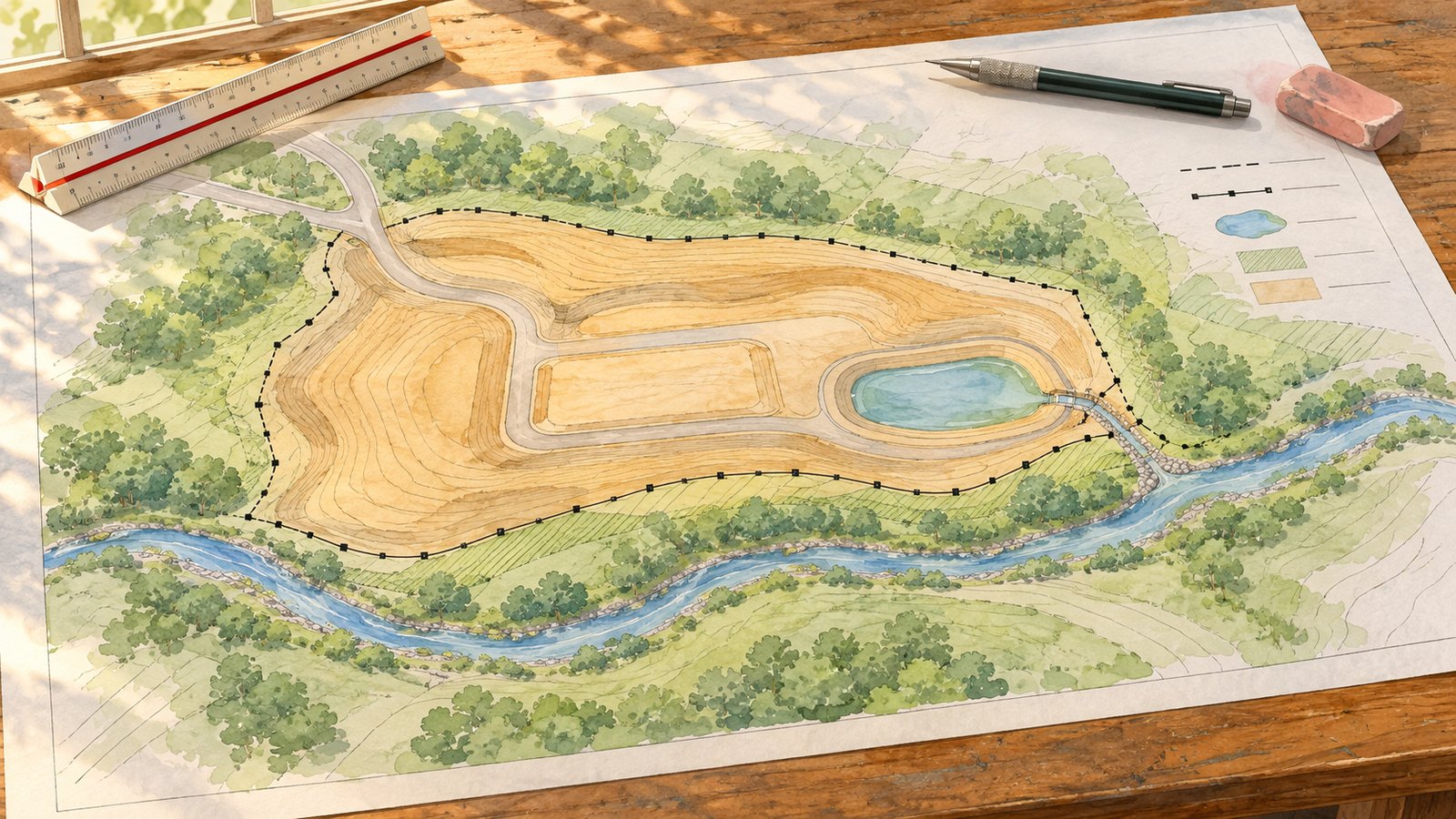
The GSWCC checklist lists what every approved plan must show, so it doubles as a reading guide[15]:
- Preparer and dates: the design professional’s GSWCC Level II certification number, signature and seal, plus the plan date and every revision[15].
- Project basics: the 24-hour contact, the primary permittee, total and disturbed acreage, and GPS coordinates of the construction exit[15].
- Phases: initial sediment storage and perimeter controls, intermediate grading and drainage BMPs, and final BMPs, each with its own limits of disturbance. Disturbing 50 acres or more at once needs EPD’s written approval[11][15].
- Water and buffers: state waters and wetlands on or within 200 feet of the site, and the 25-foot buffer along state waters or 50-foot buffer along trout streams[5][15].
- Sediment storage: at least 67 cubic yards per acre drained, in place before and during land disturbance[15].
- BMPs and notes: Green Book symbols with a legend, detail drawings, a vegetation plan, a construction sequence, and required notes, including that any area left exposed more than 14 days must be mulched or temporarily seeded[15].
From Permit Issuance to the First Day of Grading
Pre-construction meeting. Sandy Springs requires one with a site inspector before any land disturbance[20]. Gwinnett County requires it before erosion control installation, and work done earlier can bring a notice of violation and a stop work order[25]. Forsyth County issues the permit at the pre-construction conference[24].
Posting. Rules are local. Paulding County requires the permit to be displayed in plain view from a county road[26], Cherokee County requires a stamped plan set at the job site[23], and Peachtree Corners requires a copy of the approved plans on site[21]. Under GAR100001, the plan and proof of NOI submittal stay on site or at an accessible location until the notice of termination[11].
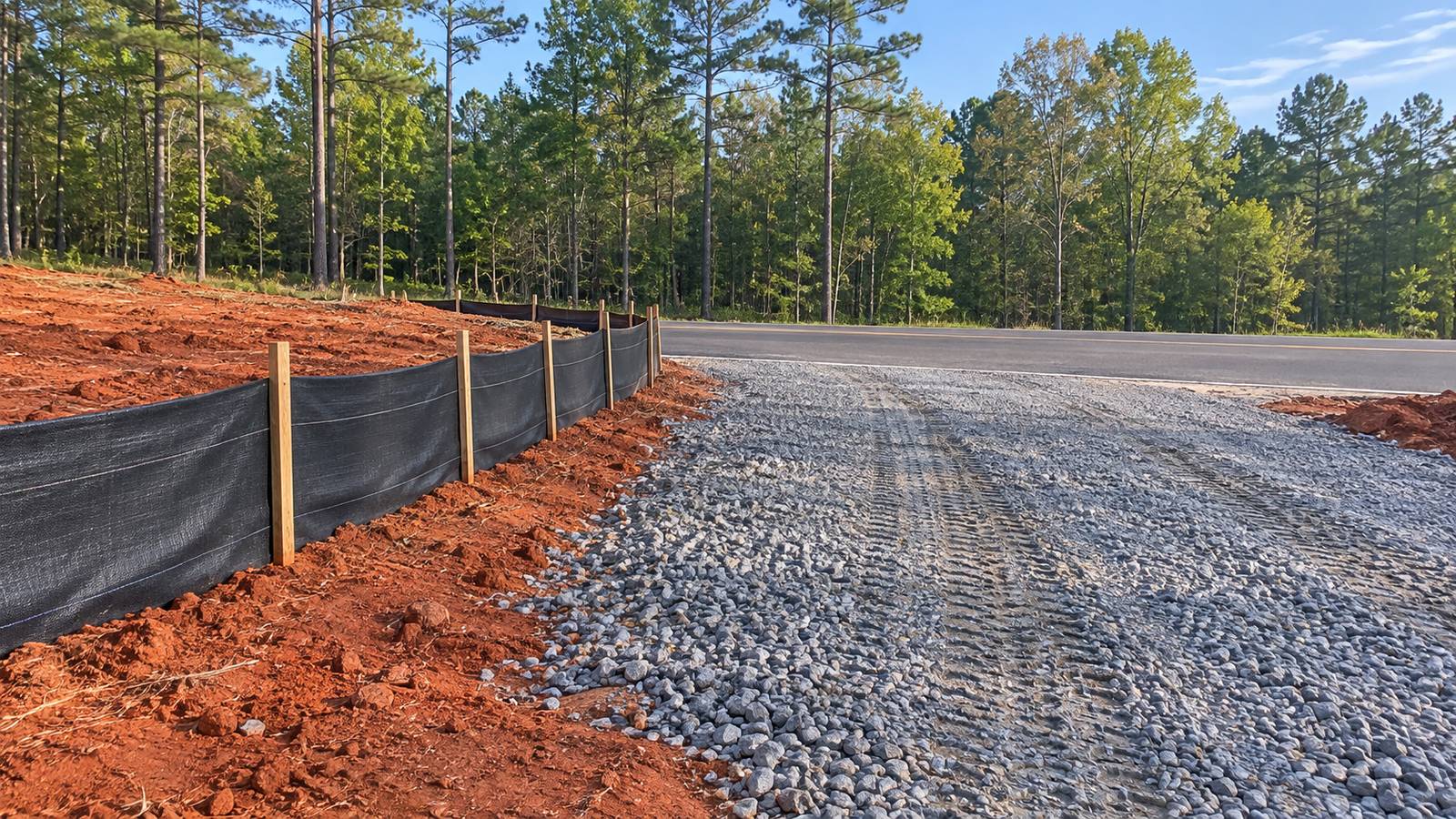
Initial BMP inspection. On stand alone NPDES sites, the design professional who prepared the plan must inspect and certify the initial sediment storage and perimeter controls within 7 days after installation, and deficiencies must be corrected within two business days of the report before construction continues[11]. Peachtree Corners issues the LDP only after the initial controls pass city inspection and the designer’s 7-day letter is in[21].
Inspections and Records During Construction
Every primary, secondary or tertiary permittee must have a certified person in responsible charge of erosion control on site whenever land is being disturbed[9]. Under GAR100001, certified personnel must[11]:
- Inspect fuel areas and every vehicle entrance and exit each day construction takes place.
- Record rainfall every 24 hours, except non-working weekends and federal holidays.
- Inspect disturbed areas, exposed material storage and structural controls at least every 7 days and within 24 hours after a storm of 0.5 inches or more.
- Inspect finally stabilized areas monthly until the notice of termination.
Inspection reports, the 7-day design professional report, NOIs, the plan and rainfall records stay on site until termination and are kept at least three years afterward[11].
Common Conditions and What Triggers a Stop Work Order
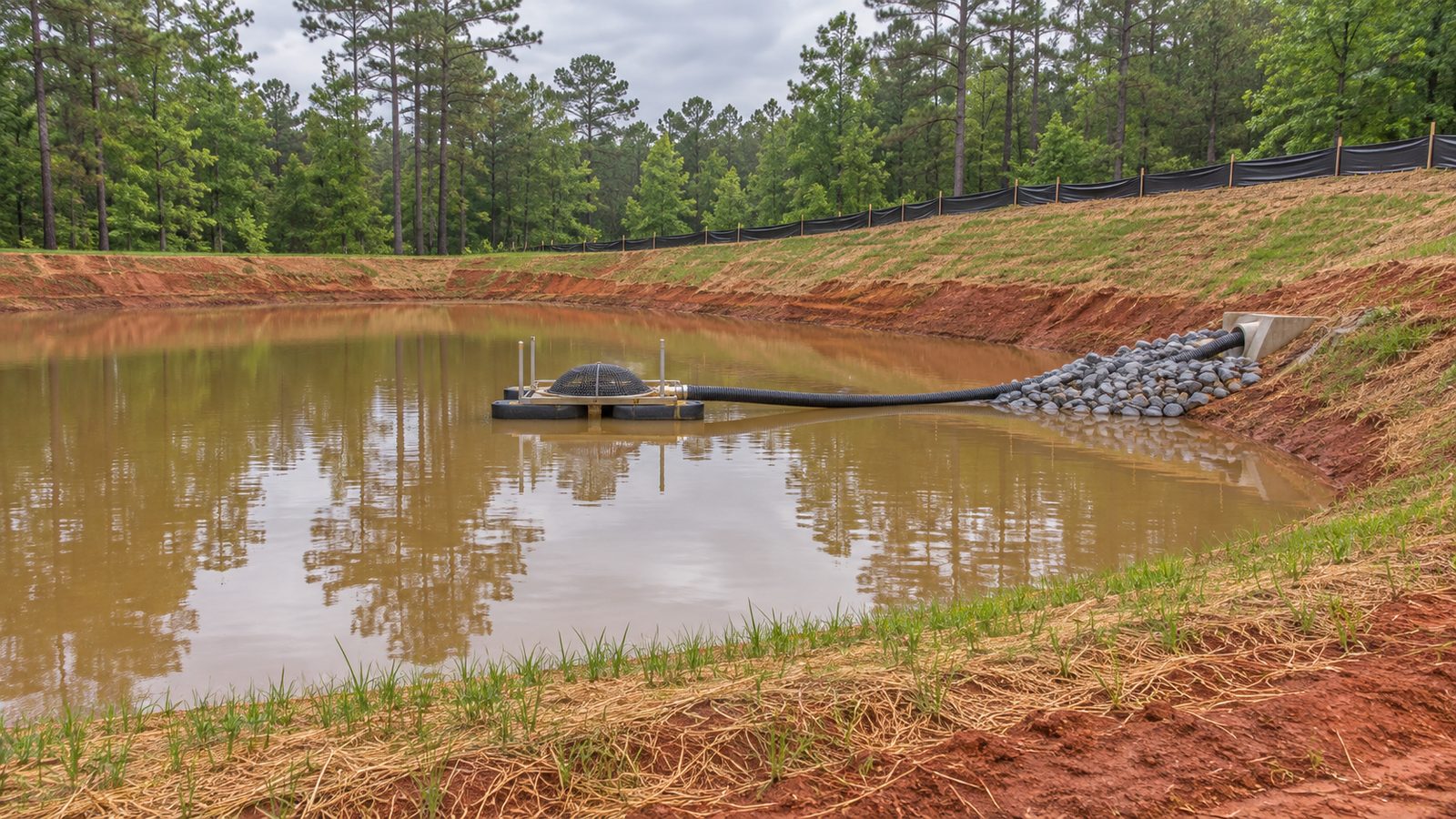
Typical conditions are to build what the approved plan shows, keep BMPs working, stay out of stream buffers, and tell any successor owner about the permit conditions[5][18]. Macon-Bibb’s permit can be modified or revoked for noncompliance[17], and Columbia County’s form warns of an immediate stop work order[18]. State law sets the enforcement ladder[6]:
- First and second violations: a written warning with five days to correct, then a stop work order if not fixed.
- Third and later violations: an immediate stop work order.
- Always immediate: an imminent threat to public health or state waters, working without a permit, failing to maintain a stream buffer, or significant sediment reaching state waters where BMPs were not properly designed, installed and maintained.
Each day BMPs are not properly designed, installed or maintained is a separate violation[5], civil penalties can reach $2,500 per day[7], and two or more violations in three years can be grounds to deny your next permit[2]. Our guide to avoiding land disturbance permit delays in Georgia covers how to keep a project moving.
Permit Expiration, Renewal and Closeout
Talk to a Civil Engineer About Your LDP
Have a site in Georgia that needs a land disturbance permit, or a permit you need help reading? Send us the parcel and project details and we will outline the plan set and permits it will need. Contact Mack Engineering or call (770) 715-7295.
Frequently Asked Questions
What is a land disturbance permit in Georgia?
A land disturbance permit (LDP), also called a land disturbing activity or LDA permit, is the local authorization required under the Georgia Erosion and Sedimentation Act of 1975 before clearing, grading or filling land. A certified county or city issues it, and the approved erosion, sedimentation and pollution control plan is part of the permit.
Who issues a land disturbance permit?
In a certified jurisdiction, the county issues permits outside city limits and the city issues them inside its limits; some water and sewer authorities also issue them. Where a jurisdiction is not certified, Georgia EPD enforces the state general permit instead.
Is the NPDES notice of intent the same as an LDP?
No. The notice of intent (NOI) is filed with Georgia EPD for coverage under the construction stormwater general permit. The LDP is the local permit. Most larger projects need both, and the NOI is filed at least 14 days before construction with a copy to the local issuing authority.
How long is a land disturbance permit valid?
It depends on the jurisdiction. Macon-Bibb County permits run up to 12 months or until the work is complete, Forsyth County permits expire after 12 or 18 months depending on zoning, and Gwinnett County development permits expire if work does not start within 12 months. Check the dates on your own permit.
What happens if erosion controls fail an inspection?
Under Georgia law, first and second violations bring a written warning with five days to correct, followed by a stop work order if not fixed. A third violation, work without a permit, buffer violations or significant sediment discharges bring an immediate stop work order, and civil penalties can reach $2,500 per day.
Do I need an LDP to build a single-family home?
Often, but thresholds are local. Sandy Springs generally requires an LDP at 1,000 square feet of disturbance, while Tucker requires one for more than one acre at a residential site or any disturbance within 200 feet of state waters. Check with your city or county before clearing.
Sources
[1] Official Code of Georgia Annotated § 12-7-3, Definitions (Erosion and Sedimentation Act). https://law.justia.com/codes/georgia/title-12/chapter-7/section-12-7-3/
[2] O.C.G.A. § 12-7-7, Permit or notice of intent required; local issuing authorities; bonds; fees. https://law.justia.com/codes/georgia/title-12/chapter-7/section-12-7-7/
[3] O.C.G.A. § 12-7-9, Applications for permits; plans; review time frames (effective July 1, 2026). https://law.justia.com/codes/georgia/title-12/chapter-7/section-12-7-9/
[4] O.C.G.A. § 12-7-10, Review of plans by soil and water conservation districts. https://law.justia.com/codes/georgia/title-12/chapter-7/section-12-7-10/
[5] O.C.G.A. § 12-7-6, Best management practices; minimum requirements; buffers. https://law.justia.com/codes/georgia/title-12/chapter-7/section-12-7-6/
[6] O.C.G.A. § 12-7-12, Orders; stop work orders. https://law.justia.com/codes/georgia/title-12/chapter-7/section-12-7-12/
[7] O.C.G.A. § 12-7-15, Civil penalties. https://law.justia.com/codes/georgia/title-12/chapter-7/section-12-7-15/
[8] O.C.G.A. § 12-7-17, Exemptions. https://law.justia.com/codes/georgia/title-12/chapter-7/section-12-7-17/
[9] O.C.G.A. § 12-7-19, Education and training requirements. https://law.justia.com/codes/georgia/title-12/chapter-7/section-12-7-19/
[10] Georgia EPD, NPDES Construction Stormwater General Permits. https://epd.georgia.gov/forms-permits/watershed-protection-branch-forms-permits/storm-water-forms/npdes-construction
[11] Georgia EPD, General NPDES Permit No. GAR100001 (Stand Alone Construction), 2023. https://epd.georgia.gov/document/document/final-2023-gar100001-permit/download
[12] Georgia EPD, Fact Sheet: NPDES Construction General Permits GAR100001, GAR100002 and GAR100003. https://epd.georgia.gov/document/publication/factsheet-npdes-construction-general-permits-may-2018pdf/download
[13] Georgia EPD, Construction Stormwater Instructions (GEOS submittals). https://epd.georgia.gov/construction-stormwater-instructions
[14] Georgia EPD, Tertiary Permittee Guidance (October 2011). https://epd.georgia.gov/document/document/gaepdgscwwtertiarypermitteeguidanceoctober2011pdf/download
[15] Georgia Soil and Water Conservation Commission, Erosion, Sedimentation and Pollution Control Plan Checklists, effective January 1, 2026. https://gaswcc.georgia.gov/document/document/checklists-2026-plan-review-final-pdf-0/download
[16] Georgia Soil and Water Conservation Commission, Technical Guidance: Manual for Erosion and Sediment Control in Georgia, 2016 Edition. https://gaswcc.georgia.gov/urban-erosion-sediment-control/technical-guidance
[17] Macon-Bibb County, Application for Land Disturbance Activity Permit. https://www.maconbibb.us/wp-content/uploads/2018/03/Land-Disturbance-Activity-Permit.pdf
[18] Columbia County, Land Disturbance Permit Application (Rev. 07/2023). https://www.columbiacountyga.gov/DocumentCenter/View/703/LDP-Application-Form-PDF
[19] Columbia County Stormwater and Environmental Services, The Enviro-Source newsletter, 2018 issue. https://columbiacountyga.gov/Archive/ViewFile/Item/117
[20] City of Sandy Springs, Land Disturbance Permits. https://www.sandyspringsga.gov/land-disturbance-permits/
[21] City of Peachtree Corners, Land Development Permit (LDP) Handbook (October 2025). https://www.peachtreecornersga.gov/DocumentCenter/View/369/Land-Development-Permit-LDP-Handbook-PDF?bidId=
[22] City of Tucker, Land Disturbance Permit Information. https://www.tuckerga.gov/land-disturbance-permits/
[23] Cherokee County, Plan Approval Customer Package. https://www.cherokeecountyga.gov/dsc/_resources/documents/Review-Checklist-Items/172020-Updated-Plan-Approval-Customer-Package.pdf
[24] Forsyth County, Unified Development Code, Chapter 7: Permits, Certificates, Fees, and Finances. https://www.forsythco.com/Portals/0/Documents/CommunityDevelopment/UDC/udc_009_ch7.pdf
[25] Gwinnett County, Unified Development Ordinance, Title 3 (amended September 26, 2023). https://www.gwinnettcounty.com/static/upload/pnd/Code/Ordinance/304/Title_3_Amended_9_26_2023.pdf
[26] Paulding County, Development Plan Review Packet. https://www.paulding.gov/DocumentCenter/View/176/Development-Plan-Review-Packet_11122?bidId=
[27] Fulton County Code of Ordinances, Appendix A, Subdivision Regulations (land disturbance permit). https://library.municode.com/ga/fulton_county/codes/code_of_ordinances?nodeId=APXASURE_ARTVIICEGRAGSUORAD12-5-07